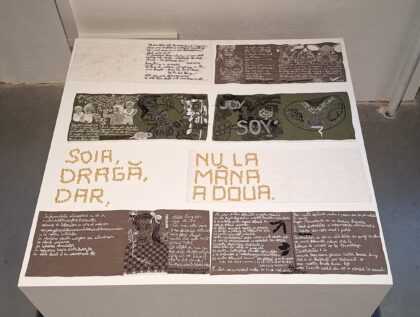
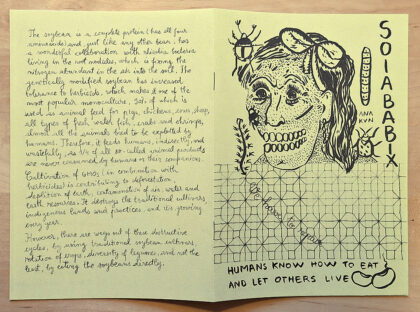
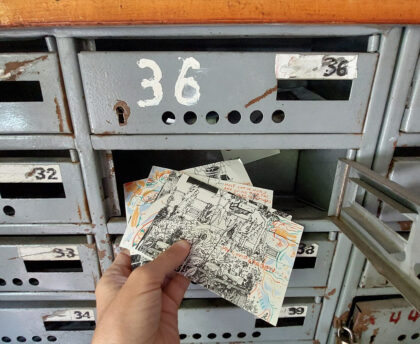
(scroll for English)
Pe scurt, iubesc soia, cam cât un șoarece de câmp.
Mai mult. Altfel.
În tempeh cel mai mult, în edamame,
Cel mai puțin în natto. Ba nu.
Cel mai puțin în GMO-ul rezistent la pesticide
Cel mai puțin în monoculturile pentru care defrișăm tototototot.
Nu scriu pentru eternitate, ci pentru momentul prezent
în care Bayer Corporation a cumpărat Monsanto cu 63 de miliarde.
63 de miliarde pentru boabele tolerante la
norii de erbicid dicamba
ce volatil seamănă moarte în câmpuri
și solubil se preling în rețeaua de apă
63 pentru semințele patentate,
pentru capitalismul contra naturii şi cultivarelor vechi,
pe care le contaminează cu semințele lor infertile
63 pentru proprietatea intelectuală și
voracitatea din sălile de judecată
63 pentru distrugerea micilor agricultori
și a sistemelor de salvaresemănarerecoltare
63 pentru erbicidul Roundup™ din glifosat ce ne dă cancer
Stai așa, ăsta i-a mai costat 10 în despăgubiri, din 2018 încoace.
E clar, au cumpărat multe cu 73 de miliarde.
Prea multe explicații pentru o poezie așa de perisabilă.
În esență:
Bayer-Monsanto etc. nu va eradica foametea,
ci doar diversitatea și
independența alimentară. Și natura, din care omul e parte.
Diversitatea nu stă în câte feluri de
pungi de plastic de unică folosință putem arde la
fabrica de ciment de la Chișcădaga.
Diversitatea e în
semințe, flori, viermi, gândaci, țânțari, bondari, fungi,
dar și în bacteriile din rădăcinile de
soia, mazăre, fasole, lupin, bob
care fixează azotul din aer în pământ. De exemplu.
Independența alimentară nu stă în
a plantaerbicizafertilizarecolta
semințe de laborator cu care să îndopăm
vaciporcigăinipăstrăvisomonisturionicrevețioamenipisicicâini
ci în rotația culturilor
în plantarea speciilor indigene sau aclimatizate
în plante-companion
în salvarea semințelor
în reducerea risipei distribuitorilor
în soluții locale și nu universale. Etc.
Atâta lume din Asia de Sud (Est mai ales)
peste 7 mii de ani au cultivat soia fără Bayer
naiba știe cum, nU șTiM, nU aVeM dAtE.
De altfel, eu nici nu mă ocup de agricultură…
AtUnCi nU-i mAi siGur sĂ mÂncĂm aLtE aNiMaLe?
Nu, mersi, nu vreau soia la mâna a doua.
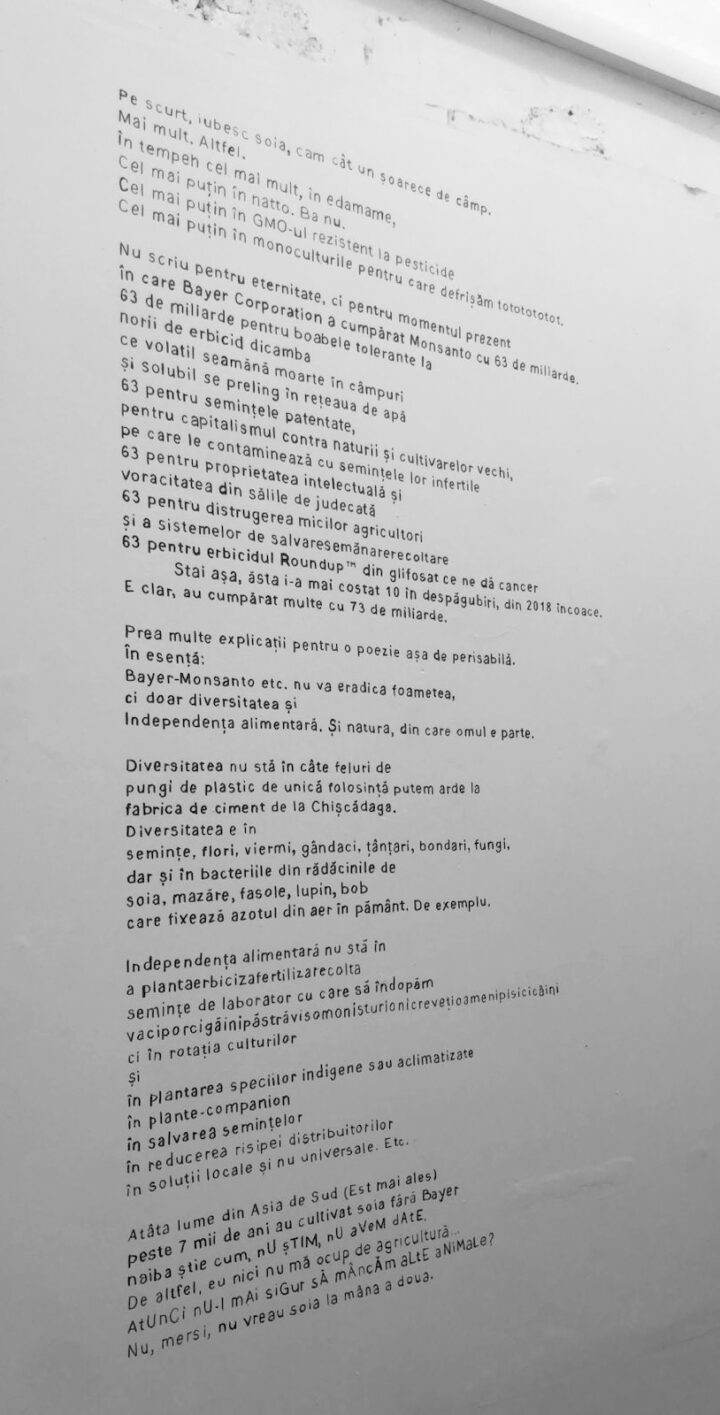
Soia, dragă, instalată pe perete de Gavril Pop, în expoziția colectivă Natură după natură, 1-18.10.2025, curatorx Ileana Pintilie, Cristi Nae, Raluca Oancea, Comenduirea Garnizoanei, Timișoara (foto Dinu Bodiciu)
Soybean, dear, Soia, dragă, 2025, poem, written on the wall by Gavril Pop
The nonfiction poem is discussing the state of nature and the loss of its diversity, of which humans are just one part, through the destructive methods of corporate agriculture. Cultivation of GMOs (in combination with herbicides) is contributing to deforestation, depletion of the earth, contamination of earth, air and water resources, it destroys the traditional cultivars and so on. However, there are ways out of these destructive cycles, by using old soybean cultivars, rotation of crops, diversity of legumes, and not in the least, by eating the soybean directly, dear.
The soybean is a complete protein (has all four amino acids) and, just as any other bean, has a wonderful collaboration with rhizobia bacteria living in the root nodules, which is fixing the nitrogen abundant in the air into the soil. The genetically modified soybean has increased tolerance to herbicide, which makes it one of the most popular monoculture, 90% of which is used as animal feed for poultry, pigs, cows, all types of fresh water fish, crabs and shrimps. Therefore, it feeds humans, indirectly. Cultivation of GMOs (in combination with herbicides) is contributing to deforestation, depletion of the earth, contamination of earth, air and water resources, it destroys the traditional cultivars (through cross pollination) and so on. However, there are ways out of these destructive cycles, by using old soybean cultivars, rotation of crops, diversity of legumes, and not the least, by eating the soybean directly, dear.
Soybean, dear
In short, I love soy, about as much as a field mouse.
More. Differently.
In tempeh the most, in edamame,
Least in natto. No.
Least in pesticide-resistant GMOs
Least in monocultures for which we are deforesting allallallallall.
I am not writing for the eternity, but for the present moment
when Bayer Corporation bought Monsanto for 63 billion.
63 billion for the grains tolerant to
the clouds of dicamba herbicide
which volatile sows death in the fields
and soluble seeps into the water network
63 for the patented seeds,
for the capitalism against nature and old cultivars,
which they contaminate with their infertile seeds
63 for the intellectual property and
the voracity in the courtrooms
63 for the destruction of small farmers
and of the saving systems of sowing-harvesting
63 for the Roundup™ herbicide with glyphosate that gives us cancer
Wait a minute, that was another 10 in damages, since 2018.
Clearly, they bought a lot with 73 billion.
Too many explanations for such a perishable poem.
In essence:
Bayer-Monsanto etc. will not eradicate hunger,
but only the diversity and
food sovereignty. And nature, which humans are part of.
Diversity is not in how many types of
single-use plastic bags we can burn at the
cement factory in Chișcădaga.
Diversity is in
seeds, flowers, worms, beetles, mosquitoes, bumblebees, fungi,
but also in the bacteria in the roots of
soybeans, peas, beans, lupins, fava
fixing nitrogen from the air into the soil. For instance.
Food independence does not lie in
plantingherbicidingfertilizingharvesting
laboratory seeds to feed
cowspigschikenstroutssalmonssturgeonsshrimpshumanscatsdogs
but in crop rotation
in planting indigenous or acclimatized species
in companion plants
in saving seeds
in reducing distributors’ waste
in local and not universal solutions. Etc.
So many people in South Asia (especially East Asia)
for over 7 thousand years have cultivated soybeans without Bayer
who knows how, wE dOn’T kNoW, wE dOn’T hAvE dAtA.
Besides, I don’t even practice agriculture…
ThEn iSn’t iT sAfEr tO eAt oThEr aNiMaLs?
No, thanks, I don’t want second-hand soybeans.
(the zine Humans know how to eat and let others live is based on this English version of the poem)